Okay:
Hier etwas gekürzt, aber (noch) nicht übersetzt, das was ich Eric geschrieben habe. Ich riet ihm, diese Punkte nochmal zu prüfen.:
Pages 3 + 54: Canon FDn 2/50: The FDn 2/50 has exactly the same dimensions, is made of the same material and looks exactly like the FDn 1.8/50. The only difference is the engraving “2” instead of “1.8” on the name plate ring and on the aperture ring. I cannot believe it was made by Cosina. The optical quality of the 2.0/50 seems to be nearly the same as that of the 1.8/50, but I did not test it with enlarged prints.
· Page 13: The two Pellixes are as noisy as the other models (FT, FX etc).
· Page 13 (perhaps only a misunderstanding): The FT was not the first one with a quick return mirror. Also FX and FP and even the Canonflexes had a quick return mirror. .
· Page 18, foot-note: The EF mount ist nearly 25 years old, not 35.
· Page 25: What do the asterisks in the chart mean? (Perhaps I did overlook the explanation).
· Page 27: The Canonflex R 2000 has an interchangeable pentaprism exactly like the Canonflex.
· Page 65: The chart on page 65 is right, you wrote: Power Winder A2 fits all A series cameras. But as far as I remember somewhere else in your book you wrote, the Winder A2 does not fit the original AE-1. I did not find the page once again for a quotation and perhaps I am wrong but I want to tell you that there might be an error.
· Page 36: The T-70 had – besides integral metering - partial metering selectable by only moving a knob. I think this was the first camera with this option (without changing Viewfinder (F-1) or screen (New F-1)).
· Page 36: The T-80 was the first Canon camera to use pictographs for selecting modes.
· Page 36: A few repair shops in the USA modified the T-90 by adding a PC socket on the pentaprism housing. Looks odd, but was sometimes necessary.
· Page 43: On FL and FD lenses there were no engravings of roman numerals, perhaps they were only listed in ads and charts.
· Page 44 + 46: Important: As far as I know (and have seen) the FDn lens series was introduced in june and september 1979, but not in 1976. (....)
· Page 44: Another wonderful Fluorite lens is the FD 2.8/300 SSC Fluorite, introduced in October 1975.
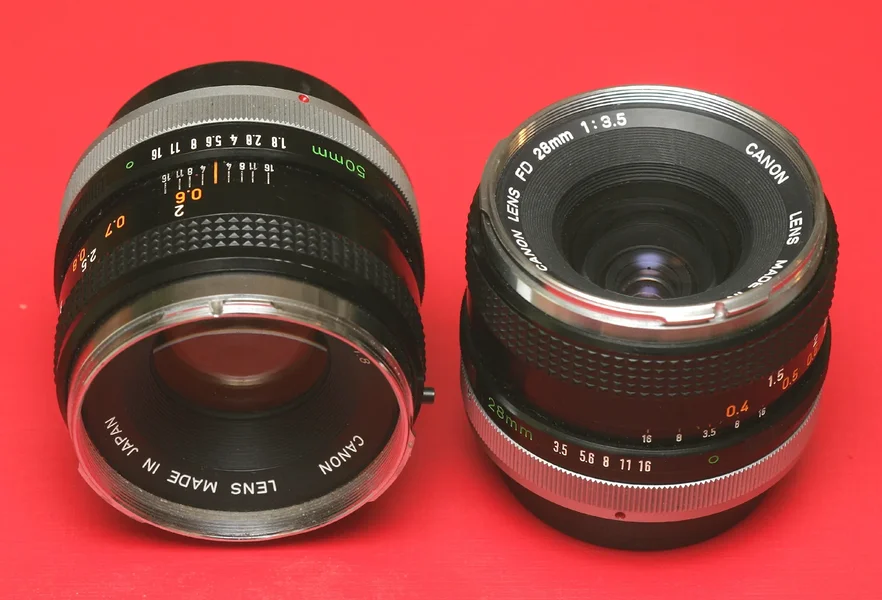
· Page 46: Chrome nose is wrong in this case. Chrome nose does not mean the bayonet mount ring. Chrome nose is the designation for the first FD lenses issued in 1971 and 1972 (for example 50mm, 35mm, 28mm, 135mm) that incorporated a chrome front tube (the metal part with the filter thread and the bayonet for the sun shades). In later lens generations this part became black and was made in some cases (not 1.4/50, but 1.8/50 late version) of plastic material.
· Page 47: Figure 3.4: The line from AE switch Pin leads to the wrong part. At 8 o’clock there is a white dot which is surely an error. The reserved pin is a challenge: Most lenses have one, a few lenses have two of these pins. Perhaps a signal for the smallest aperture? Really a great miracle...
· Page 48: The AE switch pin is not only a safeguard, it tells the camera that the automatic mode is selected on the lens.
· Page 48, line 5: Misprinting: perset instead of preset.
· Page 50: There is one extender missing: It is the Extender 2x (without A or B). It was produced and delivered with the FD 2.8/300 Fluorite. Lateron it was available as an accessory in three versions and then named A and B.
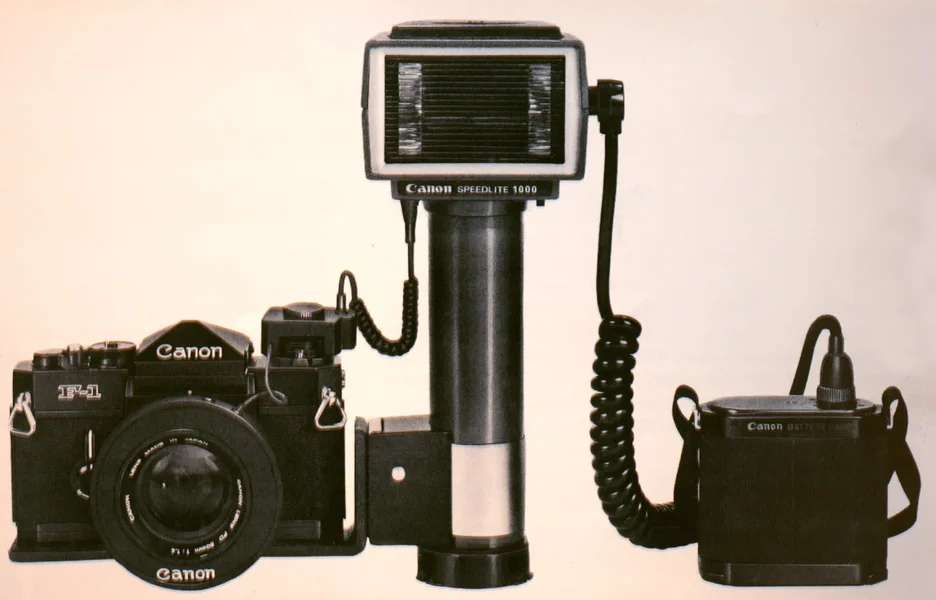
· Page 63: Some of my brochures and instructions mention the Speedlite 500A. A collector in Germany (nickname Dena) told me he has got one. As far as I remember I saw a part of his homepage in 2010 and there was a picture of that rare speedlite.
· Page 64/65: You forgot the Power Winder F for the original F-1. It had only a short life from 1979 until the debut of the New F-1.
· Page 68: Bellows R allows flipping too.
· Page 68: I think the auto bellows was introduced in the mid 70s, but not in 1971. I’ll have to look into my ads and brochures, but I do not have them at hand right now.
· Page 74: Flash coupler F was made to carry the metering cell of the Speedlites 533G and 577G, it was not made to carry Speedlites, but most photographers used it for that purpose, because the other flash couplers made it difficult to change films quick enough (I am a journalist and press photographer and used the F-1 and AE-1 during the 1980s and was very glad to get a Flash coupler F).
· Page 85: Misprinting: Leichtenstein is wrong, Liechtenstein is right.
Gruß, Thomas
Chromnasen-Objektive
Stabblitz 500A oder 1000